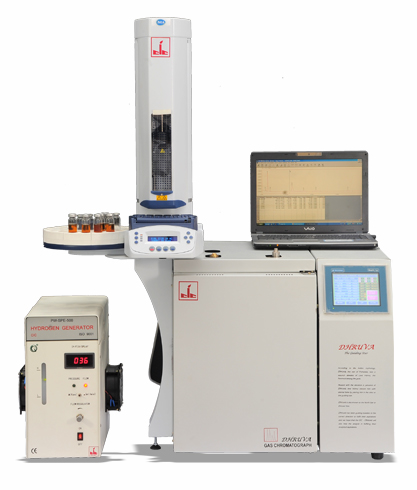
Dissolved Gas Analysis (DGA)
Mineral insulating oils are made of a blend of different hydrocarbon molecules containing CH3, CH2 and CH chemical groups linked together by carbon-carbon molecular bonds. Scission of some of the C-H and C-C bonds may occur as a result of electrical and thermal faults, with the formation of small unstable fragments, in radical or ionic form, such as H*, CH~, CH~, CH* or C* (among many other more complex forms), which recombine rapidly, through complex reactions, into gas molecules such as hydrogen (H-H), methane (CH3-H), ethane (CH3-CH3), ethylene (CH2 = CH2) or acetylene (-CH = CH). C3 and C4 hydrocarbon gases, as well as solid particles of carbon and hydrocarbon polymers (X-wax), are other possible recombination products.
The gases formed then dissolve in oil, or accumulate as free gases, if produced rapidly in large quantities. Low-energy faults, such as partial discharges of the cold plasma type (corona discharges), favour the scission of the weakest C-H bonds through ionization reactions and the accumulation of hydrogen as the main recombination gas. More and more energy and/or higher temperatures are needed for the scission of the C-C bonds and their recombination into gases with a C-C single bond, C-C double bond or C-C triple bond, following processes bearing some similarities with those observed in the petroleum oil-cracking industry.
Ethylene is thus favoured over ethane and methane above temperatures of approximately 500 °C (although still present in lower quantities below). Acetylene requires temperatures of at least 800 °C to 1200 °C, and a rapid quenching to lower temperatures, in order to accumulate as a stable recombination product. Acetylene is thus formed in significant quantities mainly in arcs, where the conductive ionized channel is at several thousands of °C, and the interface with the surrounding liquid oil necessarily below 400 °C (above which oil vaporizes completely), with a layer of oil vapour / decomposition gases in between.
Acetylene may still be formed at lower temperatures (< 800 °C), but in very minor quantities. Carbon particles form at 500 °C to 800 °C and are indeed observed after arcing in oil or around very hot spots. Analysis of DGA is well established and described in national / international standards. However, interpretation of DGA results is significant and needs expertise.
Need this test done?
Get in touch and our team will guide you through sample submission and reporting.
